
In an interview with the online outlet Politkom, Kazakh analyst Erkin Baydarov outlined the risks associated with a potential escalation around Iran – risks that, as Cronos.Asia notes, remain highly relevant today.
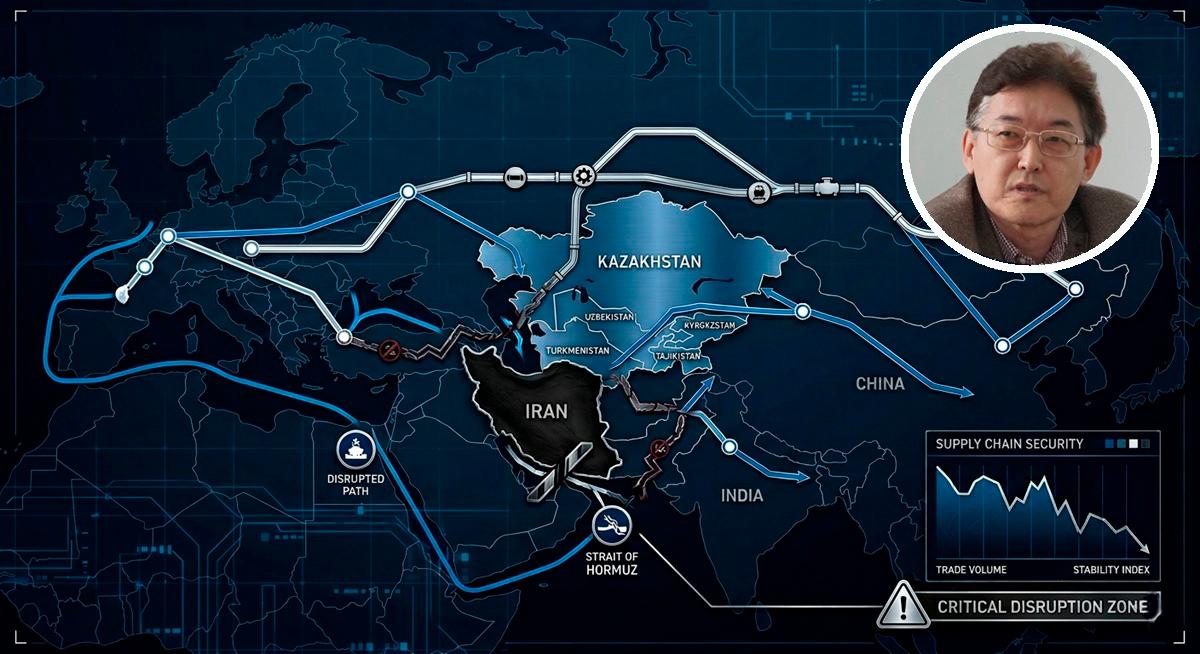
A prolonged conflict around Iran could disrupt not only regional stability but also key trade and energy corridors linking Central Asia to global markets.
Baydarov argues that Iran’s geographic position makes it a critical transit hub for landlocked Central Asian economies seeking access to the Indian Ocean. Years of investment in railways, highways and port infrastructure were designed to capitalize on that route. A drawn-out conflict, he warns, could undermine these long-term strategies.
“Iran is not just a regional actor – it is a logistical bridge,” he says. “Any instability there immediately affects the broader architecture of transport and trade across Central Asia and the South Caucasus.”
The risks extend beyond transport. The Caspian region is a dense network of pipelines, export terminals and offshore infrastructure connecting Kazakhstan, Russia, Azerbaijan and Turkmenistan. Europe’s efforts to diversify energy supplies have increasingly relied on this network, particularly via Azerbaijan.
Gas flows through the Southern Gas Corridor – including the Trans-Anatolian (TANAP) and Trans-Adriatic (TAP) pipelines – have become a cornerstone of Europe’s energy strategy. Disruption in the wider region could place additional strain on these routes.
At the same time, the economic fallout would not be limited to producers. Major importers of Iranian oil, particularly China, could face supply volatility, while Central Asian economies risk losing access to alternative export routes.
Despite these risks, forecasting Iran’s trajectory remains highly uncertain. Baydarov cautions that external analysis often fails to account for the country’s internal political dynamics and resilience under sanctions.
“Iran has operated under pressure for decades and retains significant economic and military capacity,” – he notes. – “This makes linear scenarios unlikely.”
A prolonged conflict could also trigger secondary effects – from rising sectarian tensions to a resurgence of radical movements – potentially destabilizing a region already marked by fragile balances.
For Central Asia, the priority is clear: strengthening regional coordination. Critical infrastructure – pipelines, electricity grids, transport corridors – depends on a stable security environment.
Recent diplomatic activity suggests that regional actors are moving in that direction. At an informal meeting of foreign ministers from the Organization of Turkic States in Istanbul, participants signaled a willingness to act with a “unified voice” in response to escalating tensions.
The group expressed solidarity with Azerbaijan following reported missile incidents linked to Iranian territory and reaffirmed the principle of collective security. Turkish Foreign Minister Hakan Fidan said the organization would continue efforts to support regional stability.
Such coordination may deepen if the conflict escalates. Analysts suggest that an extraordinary summit involving Central Asian states, the South Caucasus and Turkey remains a plausible scenario.
Kazakhstan’s own response reflects the constraints of its multi-vector foreign policy. Following initial strikes involving Iran, Astana expressed support for Arab states while delaying public condolences to Tehran – a move that has drawn scrutiny domestically.
Baydarov attributes this caution to Kazakhstan’s broader diplomatic positioning, including its engagement with Western-led frameworks. However, he argues that long-term realities will prevail.
“Iran remains too important to ignore,” – he says. – “For Kazakhstan, cooperation is not a choice but a necessity – particularly when so many trade and transit routes depend on it.”
In that sense, the stakes extend far beyond the immediate conflict. For Central Asia, the question is not only how the crisis unfolds, but whether the region can protect the fragile network of connections on which its economic future increasingly depends.