
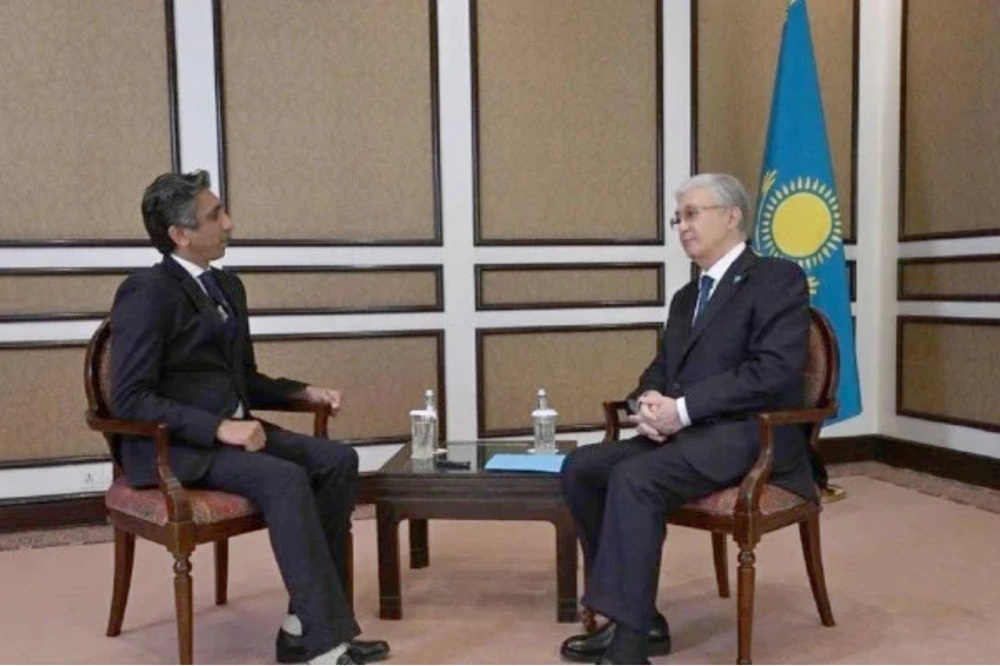
Kazakh President Kassym-Jomart Tokayev has praised Donald Trump’s approach to governance and called for greater realism in global politics, outlining Kazakhstan’s position on regional connectivity, the conflicts in Gaza and Ukraine, and the country’s ongoing political reforms in an exclusive interview, Cronos.Asia reports, citing The News Pakistan.
In an exclusive conversation with The News Pakistan, President Kassym-Jomart Tokayev presented a clear-eyed view of Kazakhstan’s place in a rapidly changing world. Speaking with the restraint and confidence of a veteran diplomat, he addressed global power dynamics, regional integration and the deep political reforms currently underway in his country.
Frequently seen as the most influential actor in Central Asia, Kazakhstan has steadily shaped its role as a connector between regions, economies and political systems. Tokayev himself reflects this positioning: a multilingual statesman with decades of diplomatic experience. At the beginning of the discussion in Islamabad, he recalled his recent talks with Pakistani Prime Minister Shehbaz Sharif, describing them in notably warm terms and framing the interview around cooperation, realism and shared interests.
Pakistan and Kazakhstan: From Diplomacy to Economic Substance
Reviewing bilateral ties, President Tokayev characterised Pakistan as a trusted partner with growing strategic importance. Since diplomatic relations were established in 1992, cooperation has expanded well beyond formal dialogue. Today, both countries work closely within major international platforms such as the Shanghai Cooperation Organisation, the Organisation of Islamic Cooperation and the Conference on Interaction and Confidence-Building Measures in Asia.
Tokayev noted that his recent state visit to Pakistan represented a qualitative shift in relations. More than 60 agreements were concluded by state institutions and private companies, opening new avenues for cooperation in logistics, transport, agriculture, industry, healthcare and education. Increasing trade volumes now stands as a central objective, while joint ventures and investment-driven projects are expected to become key drivers of the partnership.
According to the Kazakh president, political understanding must ultimately produce measurable economic outcomes. Trade, investment and direct contacts between societies, he argued, should serve as the practical foundation of long-term cooperation.
Regional Connectivity as a Strategic Priority
Transport and connectivity emerged as one of the most substantive themes of the interview. Tokayev confirmed Kazakhstan’s readiness to take part in the Kazakhstan–Turkmenistan–Afghanistan–Pakistan corridor, describing it as a strategically significant route linking Central Asia with South Asian markets. He welcomed Pakistan’s constructive stance on the initiative and stressed that its success depends on coordinated action by all participating states.
Trump, Governance and the Principle of Realism
Asked about political developments in the United States, Tokayev offered a notably positive assessment of Donald Trump. He described Trump as a decisive leader who prioritised national interests, pointing to strong economic indicators and ongoing social reforms as evidence of policy effectiveness.
Tokayev also expressed support for what he described as a return to practical governance, including firm respect for law and order. These principles, he said, are equally relevant for Kazakhstan, particularly in an era of global uncertainty. Stability, in his view, rests on adherence to the law and public trust in state institutions.
Abraham Accords and a Calculated Diplomatic Choice
Kazakhstan’s decision to accede to the Abraham Accords was presented as a calculated and interest-based move. Tokayev reiterated Kazakhstan’s long-standing commitment to dialogue and peaceful conflict resolution, arguing that the Accords provide a useful framework for reducing regional tensions and encouraging broader engagement between Muslim and Jewish communities.
At the same time, he underlined that Kazakhstan continues to support the Palestinian cause and remains committed to the two-state solution. Participation in the Accords, he added, also creates opportunities for attracting capital, technology and economic cooperation.
The Board of Peace and the Role of Global Institutions
Addressing criticism that the newly created Board of Peace might undermine the United Nations, Tokayev firmly rejected that interpretation. Established in Davos together with Prime Minister Sharif, the initiative is intended to reinforce international peace efforts rather than replace existing institutions.
He emphasised that the Board operates in line with UN Security Council Resolution 2803 and is designed to respond more swiftly to emerging conflicts. Flexible mechanisms, grounded in international legitimacy, are essential for effective peace-building, Tokayev argued.
Gaza, Ukraine and Diplomatic Limits
Turning to the situation in Gaza, Tokayev described the peace initiative proposed by US representatives as structured and realistic, with elements resembling a development-focused roadmap. However, he warned that without genuine political commitment to a two-state framework, sustainable peace would remain elusive.
On the war in Ukraine, the Kazakh president reaffirmed his country’s consistent position in favour of a negotiated settlement. Kazakhstan does not seek the role of mediator, he said, but remains prepared to offer neutral ground for dialogue should the opportunity arise.
Greenland and the Boundaries of International Law
When asked about speculation surrounding Greenland, Tokayev dismissed military scenarios and instead pointed to established international practices. Long-term leasing arrangements for strategic territories or infrastructure, he suggested, could offer pragmatic solutions without infringing on sovereignty — provided international law and the UN Charter are strictly respected.
Political Reform Inside Kazakhstan
Domestically, Kazakhstan is experiencing a profound phase of political restructuring. Tokayev described a conscious move away from a super-presidential model toward a system with stronger institutional balance and accountability. Human rights and fundamental freedoms, he stressed, are now placed at the centre of state policy.
Reforms include institutional reorganisation and renewed emphasis on social cohesion, interethnic harmony and interfaith dialogue as core pillars of national stability.
Technology, Growth and the Future Path
Looking to the future, Tokayev outlined a development strategy aimed at preserving Kazakhstan’s economic leadership in Central Asia while accelerating its transformation into a digital and innovation-driven state. With GDP exceeding $300 billion and record-high income levels, the country is prioritising artificial intelligence, advanced technologies and comprehensive modernisation of the energy sector in cooperation with foreign investors.
Ultimately, Tokayev summarised Kazakhstan’s direction in clear terms: building a secure, fair and forward-looking state where economic competitiveness directly contributes to improved living standards.
Source: The News Pakistan